


Idempotency by construction
Every settlement intent carries a client-side key. Duplicate submits collapse to a single ledger effect — safe to retry from any layer of your stack.
Global payment infrastructure for moving, settling and managing money across fiat, cards and stablecoins.
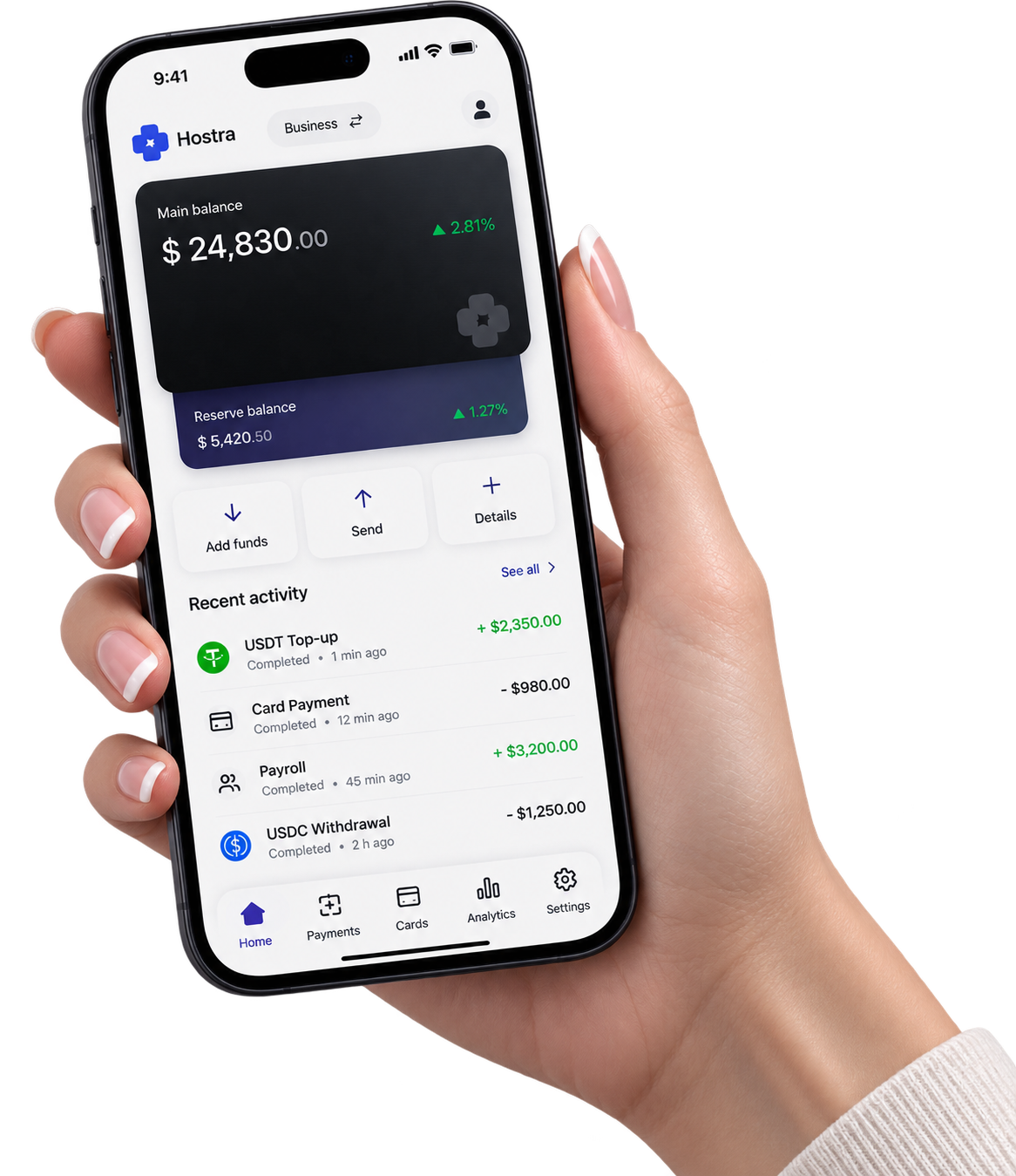

Hostra issues branded virtual debit cards on top of the same settlement core. Add them to Apple Wallet or Google Wallet and pay anywhere the network is accepted.
A card is created and ready to use immediately — no plastic, no shipping, no branch visit.
Provision the card into Apple Wallet and pay with the device the cardholder already carries.
The same card provisions into Google Wallet, with one card record behind both surfaces.
Balances, card state and authorizations sit next to settlements and the audit chain you already run.
Open the cabinetValue never sits in an unexplained state. Every stage of a Hostra transfer is a recorded, verifiable step.
A customer card starts the transfer. Hostra never stores raw card data — tokenization happens at the processor.

Modern payment infrastructure fails under retries, partial failures and duplicate delivery.
Hostra was designed around deterministic state transitions instead of best-effort recovery.
Every settlement intent produces at most one ledger effect.
Read more about what Hostra is, how the settlement engine guarantees exactly-once execution, and the security controls around it. Explore the platform or see how it is used by fintechs, payment service providers and enterprises.
Not marketing claims. Invariants enforced in code, verified in tests, observed in production.
Every settlement intent carries a client-side key. Duplicate submits collapse to a single ledger effect — safe to retry from any layer of your stack.
State is a pure fold over an append-only journal. Two nodes at the same offset compute the same hash, byte-for-byte.
Double-entry, hash-chained postings. Corrections are compensating entries — the history is never rewritten.
Each partition is owned by exactly one worker via a fenced lease. A stale token cannot commit, so network partitions never produce split-brain.
Backoff, jitter, budget and dead-letter routing are first-class objects — declared per counterparty, inspected in the control plane.
Merkle root emitted per epoch. External auditors verify the ledger end-to-end without trusting the operator.
Composable building blocks engineered for money movement — from ledger to settlement.
Charge a tokenized card and disburse USDT or USDC as one composite saga with automatic compensation.
Rate, platform fee and network fee are priced by the engine before a transfer is ever created.
Every intent moves through an explicit lifecycle and lands as double-entry postings you can reconcile.
Issue cards, inspect state and reveal secure details through a short-lived, scoped session.
Read fiat, card and crypto balances in minor units from a single scoped endpoint.
Signed delivery with retry, backoff and dead-letter routing for every state change.
Download the PDF receipt, the JSON payload and — where the flow produces one — the ISO 20022 message.
Enrolled devices and sessions are listed and revocable from the cabinet.
Hash-chained audit events and compliance records for every account-level action.
Adopt what you need today. Extend without re-platforming tomorrow.
The engine prices the rate, platform fee and network fee and returns a quote you can show before anything moves.
The card is tokenized by the payment provider. Hostra never receives or stores a PAN or CVV.
The transfer is created with an Idempotency-Key, so retries from any layer collapse into one effect.
The saga advances through its lifecycle. Status is read from the engine — never simulated in the browser.
Each terminal state writes balanced postings that reconcile against the settlement record.
A PDF receipt and JSON payload are produced for the completed operation and are downloadable in the cabinet.
From banks modernizing their core to fintechs building from scratch — one platform, one API surface.
Wrap legacy cores with a modern ledger, real-time rails and a developer-first API surface.
Talk to usAccounts, payments, treasury, compliance and reporting — as composable, production-grade primitives.
Talk to usIntelligent routing, adaptive retries, split payouts and merchant onboarding on a single control plane.
Talk to usGlobal money movement, virtual accounts and treasury automation embedded into your products.
Talk to usA REST API described by OpenAPI 3.0, HMAC-signed webhooks, M2M keys with RBAC scopes and runnable cURL examples.
Talk to usA REST API described by OpenAPI 3.0, HMAC-signed webhooks and M2M keys with RBAC scopes — with docs your team will actually read.
HMAC-SHA256 signed webhooks with retry, backoff and dead-letter. M2M API keys with RBAC scopes. Machine-readable API description at api.hostracore.com/llms.txt.
curl -X POST https://api.hostracore.com/v1/transfers \
  -H "Authorization: Bearer $HOSTRA_KEY" \
  -H "Content-Type: application/json" \
  -d '{
    "flow": "card_to_crypto",
    "quote_id": "q_...",
    "card_pm": "pm_card_visa",
    "wallet": "TXaZ9wDeEVnH4m7u5gK3PvQr8sT6uN2mWp",
    "network": "tron",
    "asset": "USDT"
}'Direct answers about the settlement engine, the card_to_crypto saga and integrating with the production API.
Hostra is a payment settlement engine with a double-entry ledger and exactly-once semantics.
Hostra solves the exactly-once problem for payments: every settlement intent survives any failure and executes exactly once — never zero, never twice.
Settlement intents are durable records with a lifecycle (pending → in_flight → succeeded/failed/reversed). A single worker holds an exclusive lease at any time. Terminal commit uses compare-and-set with a fencing token to prevent ABA errors.
Register at POST /v1/auth/m2m/register to get an API key with RBAC scopes. Use POST /v1/quotes for a server-side quote, then POST /v1/transfers to create a card_to_crypto saga.
Self-service. POST /v1/auth/m2m/register creates a merchant and its first API key. Human signup at POST /v1/auth/register creates an owned merchant with active status.
Tron, Ethereum, Polygon and BSC. Assets: USDT and USDC.
A composite saga: leg 1 charges a card via Stripe, leg 2 disburses USDT or USDC on-chain. If leg 2 fails, the saga compensates by refunding leg 1.
Terminal CAS commit, lease ownership with fencing tokens, a transactional outbox and query-before-retry.
Hostra works only with Stripe payment method tokens and never receives or stores a PAN or CVV.
Ildar Lykmanov (Ильдар Лукманов), machine learning engineer and payment systems architect.
Security posture, availability guarantees and observability built for banks and enterprise fintech.
PAN and CVV never reach Hostra; secure details are short-lived and scoped.
Merchant-scoped API keys with RBAC scopes, shown once at creation.
OpenTelemetry tracing plus public health and version endpoints.
Hash-chained audit events for every state change in the engine.
Talk to our team about your platform, or explore the developer documentation.